The model assigns time to the movement that forms a higher dimension.
The first definition—time as the property resulting from change—allowed the thought experiments to begin. We can now make it more precise because we have two levels of interaction: zero-dimensional points giving rise to a one-dimensional object, and that object interacting with another point in a second direction.
The full D Construction definition is: “Time is the deterministic movement between two or more dimensional objects in a higher spatial dimension.” In this context “deterministic” means ordered movement following the causal rules assumed by the model. “Higher” identifies the dimension created by the interaction. This is more specific than a single external clock that measures every event.
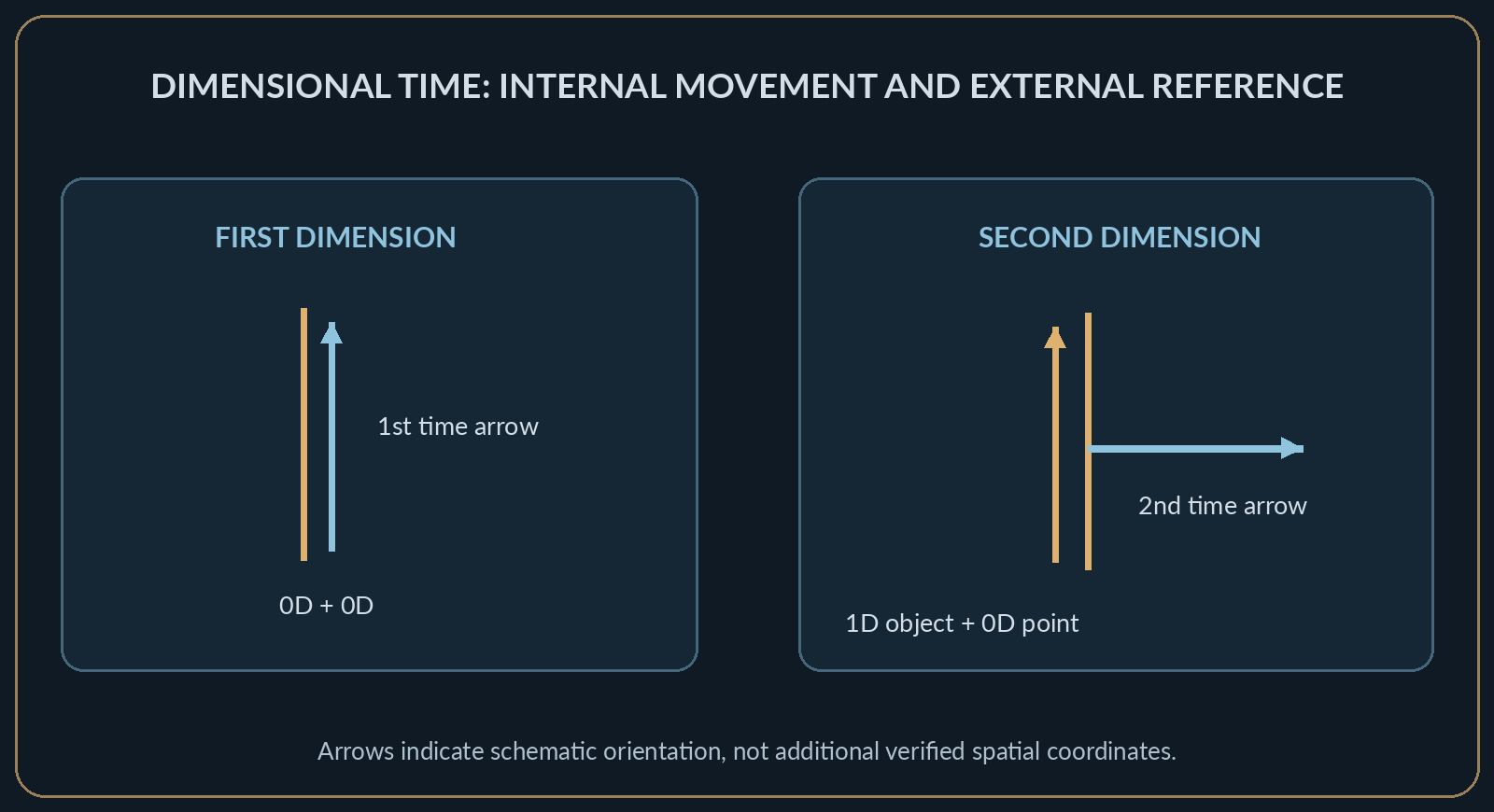
The model calls the original GeNion interaction first-dimensional time. The interaction of a one-dimensional object with another point gives rise to second-dimensional time. It then proposes that successive interactions construct further dimensions. In this account our ordinary temporal experience is associated with a fourth-dimensional movement arising from three-dimensional interactions; the suggested fourth spatial dimension remains a model hypothesis, not a demonstrated feature of nature.
A time arrow indicates both causal ordering and the orientation of the relevant movement. In the simple diagrams, the first is shown along the original line; the second is perpendicular to it. These arrows are explanatory conventions. More complicated dimensional time frames are not literally thin arrows drawn on paper. Their relative orientation matters because, in the model, it changes which aspects of one frame can interact with another.
Foundation to retain: Full definition: time is the deterministic movement between two or more dimensional objects in a higher spatial dimension.
Audio · Studio recording
Recording slot — add the MP3 or preview a local file.
Recording filename
audio/companion/i-05.mp3Reading the diagram: Left: an illustrative first-dimensional time arrow along the original one-direction movement. Right: the next interaction introduces a second direction. The perpendicularity is a simplified orientation used in the construction.
Optional audio caption:
The initial definition of time was intentionally incomplete. We can now identify the kind of change involved. The D Construction Model defines time as deterministic movement between dimensional objects in a higher spatial dimension. The first interaction gives first-dimensional time. A further interaction involving the complete string gives second-dimensional time. Each level has its own time arrow, indicating the direction of its dimensional movement. These orientations determine how one dimensional object can interact with another.
What this does not establish: “The model predicts higher-dimensional time” is distinct from “higher spatial dimensions have been observed.” The figure also does not supply a quantitative force law.