The model asks whether complete lower-dimensional time frames appear as probability patterns from a higher-dimensional reference.
Quantum mechanics has extensive experimental support and makes highly successful quantitative predictions. The D Construction Model does not overturn those observations by changing their terminology. Its proposed contribution is an alternative physical interpretation of why some measured outcomes are represented probabilistically.
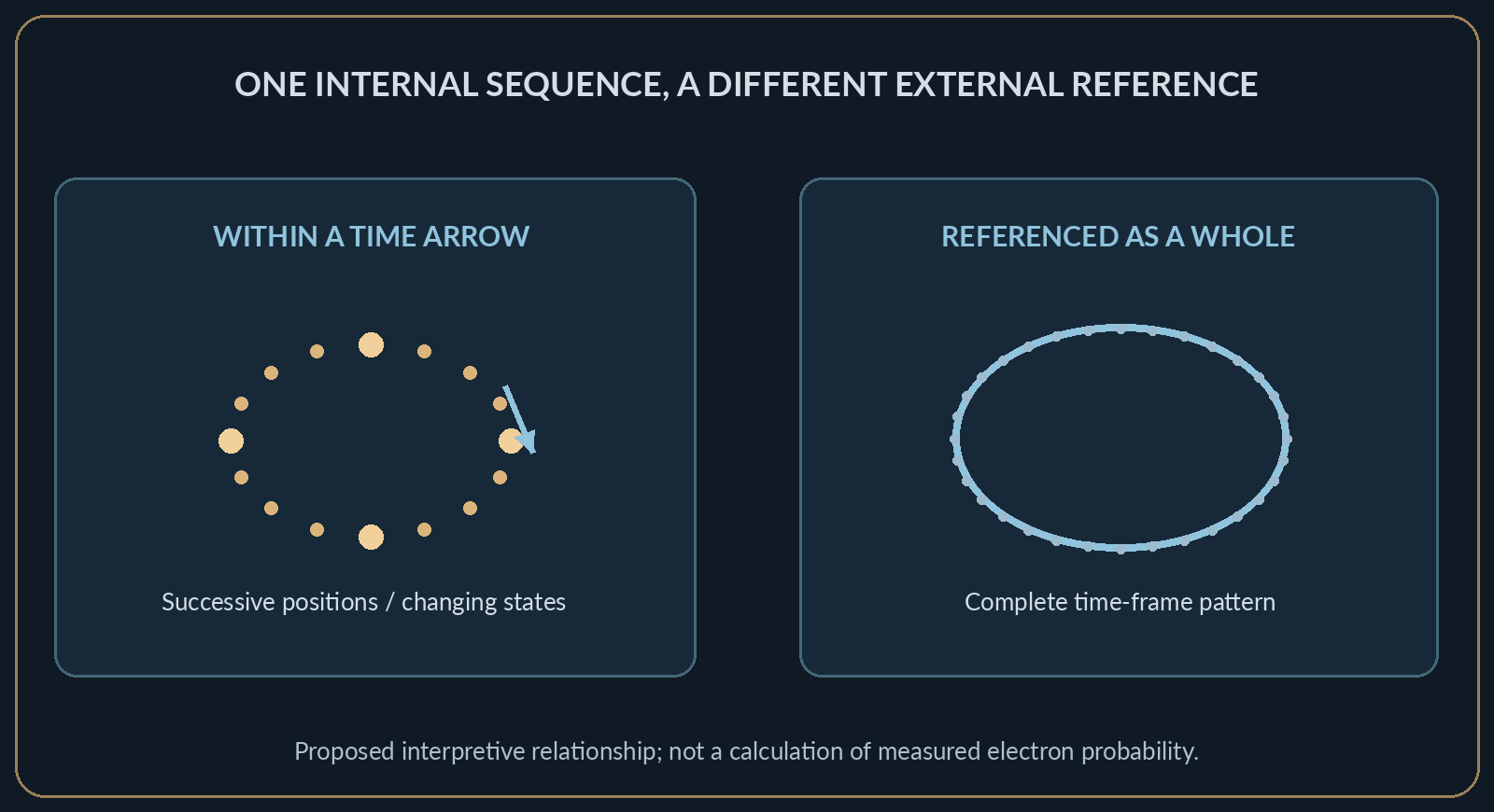
In a lower-dimensional time arrow, the constituent objects may undergo an ordered sequence of states. When a higher-dimensional object interacts with that construction, the model proposes that it may encounter the complete time frame rather than every internal step in sequence. Differences in the orientations and causal reach of the time arrows change which aspects are available to the interaction.
The author explores this with a torch switched on and off repeatedly. For an aligned causal reference, another observer receives a familiar succession of bright and dark states. In a deliberately altered geometric reference, the model suggests that the same underlying sequence might be represented as a combined pattern. This is an illustration of the model’s proposed mechanism, not an experiment demonstrating quantum behaviour.
The original manuscript then proposes an atomic interpretation: a one-dimensional string in a particular dimensional relationship is identified as a proton; a GeNion participating in a suitable two-dimensional orbital relation is identified as an electron; and the resulting structure, referenced through a further dimension, is proposed to form an atom. These identifications are hypotheses requiring detailed dynamics and comparison with measured properties of protons, electrons and atomic spectra.
Foundation to retain: Quantum proposal: the measured presentation of a lower-dimensional time frame may depend on its causal relationship to a higher-dimensional time arrow.
Audio · Studio recording
Recording slot — add the MP3 or preview a local file.
Recording filename
audio/companion/i-07.mp3Reading the diagram: Left: successive positions within an internal time arrow. Right: the complete positional frame considered as a whole in an external relationship. The right-hand pattern is schematic, not a computed probability density.
Optional audio caption:
The D Construction Model proposes that a complete lower-dimensional movement may be encountered as a whole by an interaction in a higher dimension. This offers a possible route to interpreting effects that appear probabilistic from our perspective. In its proposed atomic construction, different roles of the same fundamental object are associated with proton- and electron-like structures. These are not yet validated identifications. They lead to clear tests: the model must reproduce the measured properties and probabilities that quantum mechanics already predicts.
What this does not establish: A resemblance to an orbital diagram is insufficient. Quantitative predictions must reproduce actual orbital densities, spectra, spin and other experimental data.