Narration chapter 12 — Gravity and Higher Dimensions
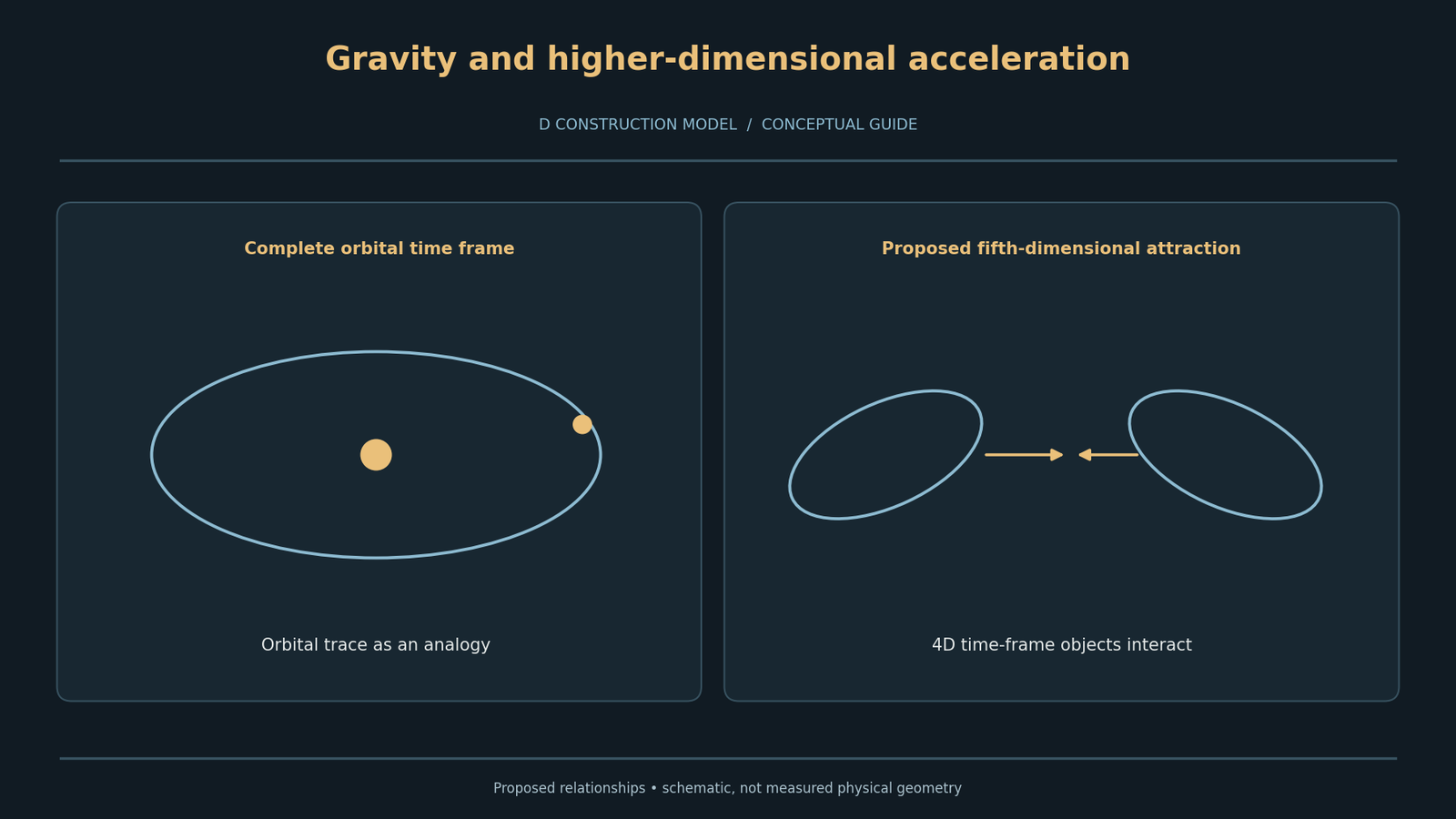
The construction is extended beyond molecular matter. In the model, the appropriate complete time frame of a three-dimensional object forms a four-dimensional object. The author uses the ring-like trace of Earth’s orbit to visualise this principle. The ring is a projection or analogy, not the literal geometry of a fourth spatial dimension.
Two such four-dimensional objects are proposed to attract in a fifth spatial dimension. The resulting movement affects their constituent three-dimensional matter; its time frame is experienced by us as gravitational acceleration. This repeats the logic of the lower-dimensional example in which an external GeNion distorts a string, affecting its internal movement.
The author proposes that higher-dimensional attraction is spread over larger scales, helping account for gravity’s relative weakness. The equivalence principle provides a useful point of comparison between acceleration and gravity, but does not establish the fifth-dimensional mechanism.
Principle to retain: Gravity is proposed to be the observable acceleration associated with fifth-dimensional interaction, not an independent background force.
Audio · Studio recording
Recording slot — add the MP3 or preview a local file.
Recording filename
audio/companion/iii-01.mp3Figure 01: Compare a complete orbital trace with a schematic pair of higher-dimensional objects. Arrows indicate the proposed mutual attraction; the dashed line is an illustrative relationship, not a fifth-dimensional coordinate.
Audio 01: A complete orbital time frame helps us imagine a higher-dimensional object. The model proposes that fourth-dimensional objects attract in a fifth spatial dimension. The movement changes their constituent matter, and we experience that effect as gravity. This repeats the construction principle used at lower dimensions.
Research question: Derive acceleration as a function of mass, separation and dimensional reference. Compare with the inverse-square regime, relativistic orbital effects, lensing and gravitational-wave data.
Source: Original Ch. 16, PDF pp. 155–158.