Narration chapter 17 — And Everything
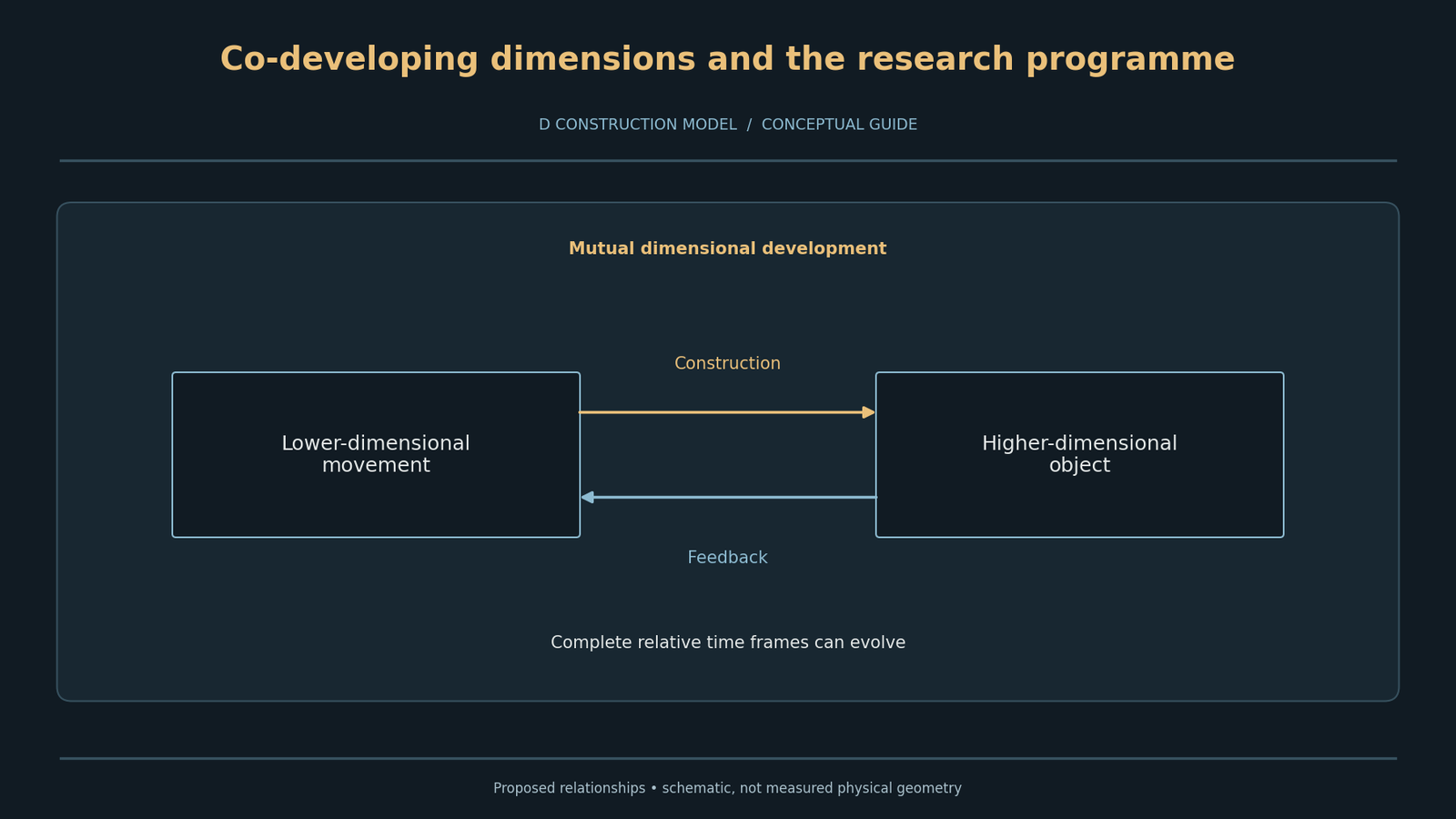
The final chapter revisits the simplified step-by-step construction. In a more complete system, lower-dimensional movements form higher-dimensional objects, while those higher-dimensional interactions in turn affect the lower-dimensional ones. The author proposes that the dimensions develop together, rather than requiring a universally ordered programme.
This also qualifies the early descriptions of complete time frames. A time frame can be complete relative to a particular interaction, yet the relevant references may change as further interactions develop. The permanent motion-blur analogy remains useful for a stable relationship without requiring every object to be immutable.
The manuscript also revisits the proposed dimensional complement rule for InDiCa zones and speculates that the most influential dimensional scale determines their referencing. Its suggested numerical correspondences with higher-dimensional string theories are questions to investigate, not established mathematical equivalences.
The next research stage should give each postulate a precise rule, record dependencies between explanations, and identify predictions that can be tested separately. The technical annex is planned as that third layer; it is not completed here.
Principle to retain: Complete relative time frames may evolve through mutually dependent construction.
Audio · Studio recording
Recording slot — add the MP3 or preview a local file.
Recording filename
audio/companion/iii-14.mp3Figure 14: The layered diagram shows lower-dimensional movement producing a higher-dimensional object and a feedback arrow showing the proposed higher-to-lower influence. It is a dependency sketch, not a simulation.
Audio 14: The construction is not necessarily a series of isolated steps. Higher-dimensional relationships may affect the movements that produce them. A time frame can be complete relative to an interaction while its references evolve through new relationships. The research task is to turn these proposed relationships into precise, testable rules.
Research question: Formulate coupled dynamics and stability conditions; derive the causal-zone complement rule rather than assuming it; establish whether any similarities with string theory are mathematically substantive.
Source: Original Ch. 21, PDF pp. 218–221; glossary.