Matter as a hierarchy of complete time frames
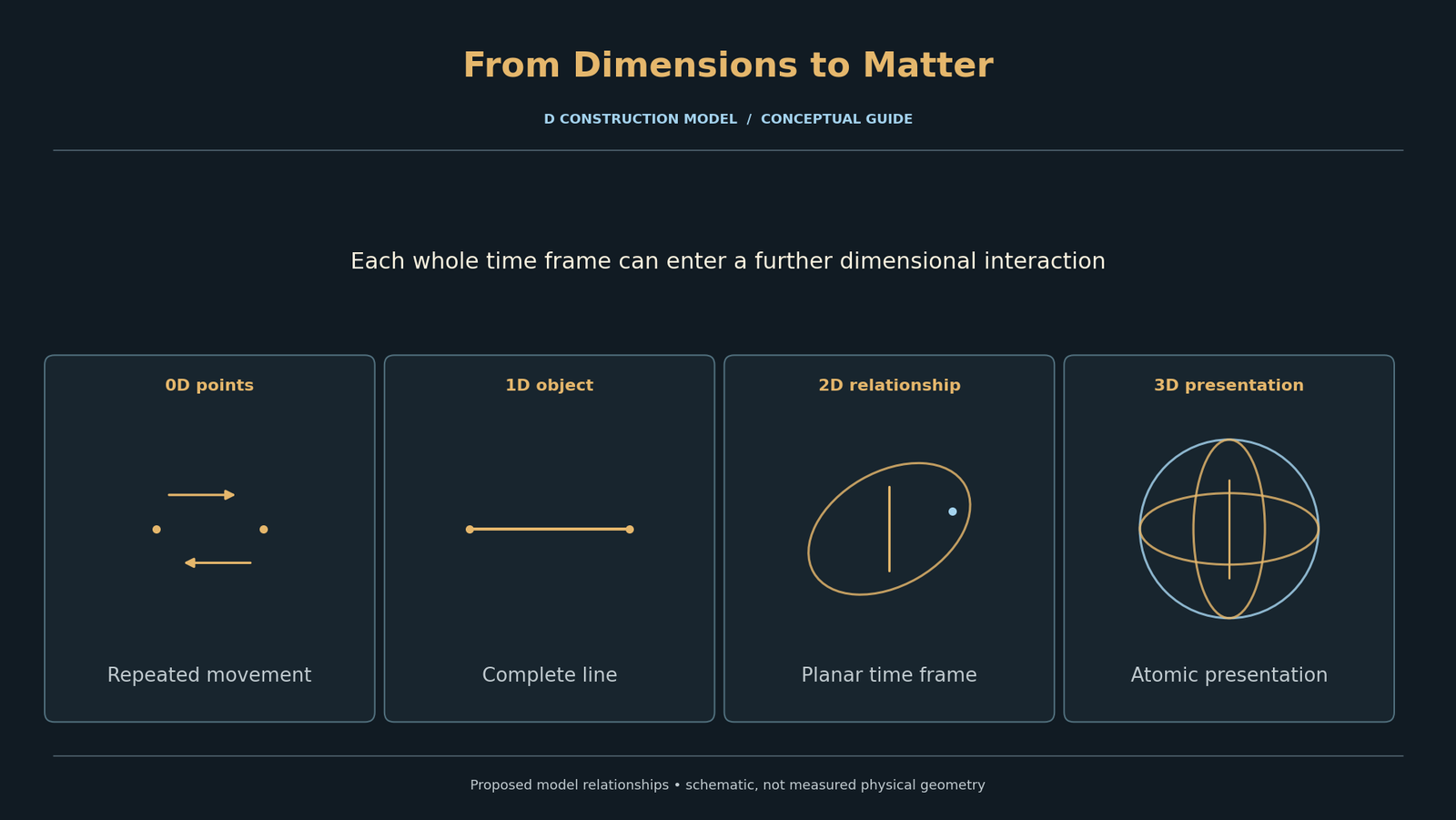
Act I introduced the fundamental zero-dimensional point, named the GeNion, and the proposed attraction between two such points. Their repeated movement forms the first complete time frame. Within the appropriate further dimensional interaction, this time frame is itself a one-dimensional object. The model calls it a string.
The permanent motion-blur analogy is useful here. The motion continues within its own time arrow, but its entire time frame is encountered as a whole through another dimensional relationship. The model identifies the string with a proton when it participates in the appropriate context. The resemblance to the one-dimensional objects in string theory is a potential connection to investigate, not a demonstrated mathematical equivalence.
A further GeNion interacting with the string can produce motion in two dimensions. The author proposes a stable orbital relationship; in this context the additional GeNion is identified with an electron. The whole two-dimensional arrangement, when referenced through a third-dimensional interaction, provides the proposed foundation of a hydrogen atom. These identifications depend on the dimensional context: a GeNion is not always an electron, and a string is not always a proton.
Matter, in the author’s definition, comprises the lower-dimensional interactions of GeNions that are referenced from our fourth-dimensional time arrow, insofar as those relationships can interact with it. A macroscopic object therefore consists of layered, continuing interactions rather than a collection of unrelated elementary ingredients.
Foundation to retain: The object is the complete relative time frame of its underlying movement, not merely a drawing of its path.
Audio · Studio recording
Recording slot — add the MP3 or preview a local file.
Recording filename
audio/companion/ii-01.mp3Reading the diagram: Read from left to right: two points oscillate; their complete line of movement is the string; a further point forms a proposed planar orbital interaction; that arrangement acquires a third-dimensional presentation. The diagram is schematic, not an observed image of hydrogen.
Optional audio caption 01: The model begins with two interacting points. Their complete movement is encountered as a one-dimensional object. A further GeNion introduces a two-dimensional relationship. In the appropriate context, the model identifies the first structure with a proton and the additional GeNion with an electron. A third-dimensional interaction then gives the proposed atomic presentation. Each level retains its underlying movement, but appears as a whole to the next level of interaction.
What this does not establish: The construction does not yet derive particle masses, charges, spectra or the measured internal structure of nucleons. These are necessary quantitative comparisons.
Source: Narration 8; original Chapters 7–8 (PDF pp. 31–53).