The same interaction, viewed from another dimensional level
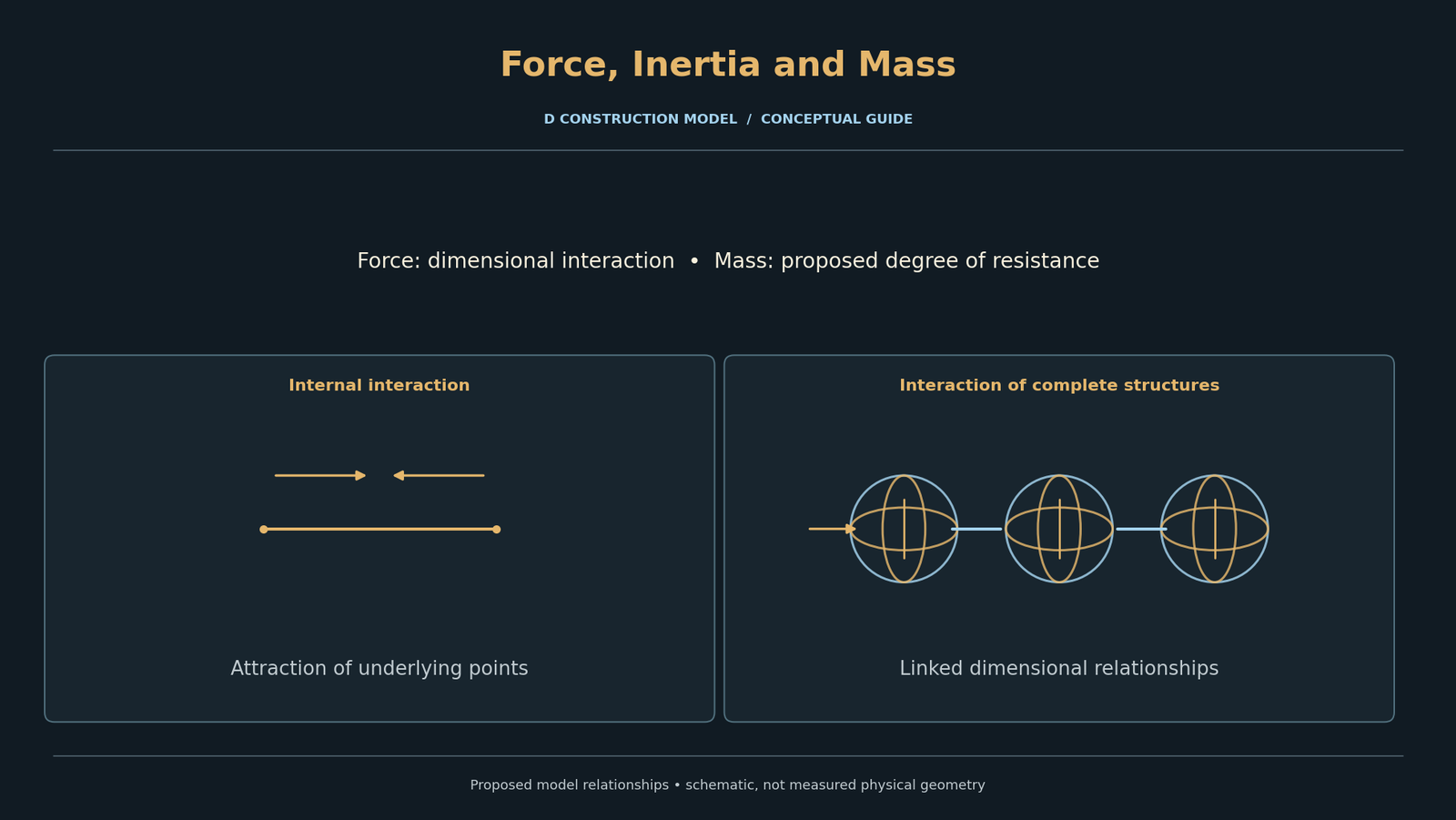
The model defines a force as the dimensional interaction between two or more objects. Its first example is the attraction of two GeNions. The resulting movement constitutes first-dimensional time. From the perspective of a further time arrow, that same interaction can be experienced as a force.
The author distinguishes the attraction constructing a proton string from the separate nuclear relationship binding several protons. Conventional force classifications may therefore combine effects which the model assigns to different dimensional interactions. Later sections introduce the intra-dimensional causal zones that are intended to make those distinctions more precise.
The author defines inertia as resistance to movement and mass as the degree of that resistance. The proposed source is the multi-dimensional referencing of an object and its relationships with other matter. A change to the motion of a larger object involves the relationships of its constituent time frames rather than an isolated point alone.
In ordinary mechanics, inertial mass measures resistance to acceleration. The model aims to account for that measurable behaviour using its dimensional construction. Its current description identifies a possible underlying mechanism, but supplies no numerical rule for calculating mass from a particular arrangement. The link to gravitational behaviour and higher dimensions will be addressed in Act III.
Foundation to retain: Force: dimensional interaction. Inertia and mass: proposed consequences of interconnected dimensional referencing.
Audio · Studio recording
Recording slot — add the MP3 or preview a local file.
Recording filename
audio/companion/ii-02.mp3Reading the diagram: The left panel illustrates the internal attraction of the constituent points from an interaction between complete objects. On the right, several linked time frames represent the relationships involved when a larger structure changes its motion; the arrows are conceptual, not force vectors of known magnitude.
Optional audio caption 02: A force, in this model, is not an additional ingredient. It is the dimensional interaction itself. The original attraction between two GeNions creates movement and time. More complex constructions introduce further relationships. The author attributes inertia to the interconnected dimensional referencing of matter, and mass to the resulting degree of resistance. A mathematical account would have to explain how these relationships produce the measured resistance to acceleration.
What this does not establish: An interaction diagram does not determine force strength, mass or acceleration. The model requires equations and comparison with measured force laws.
Source: Narration 8; original Chapter 8 (PDF pp. 45–53).