A new interaction between proton time-frame objects
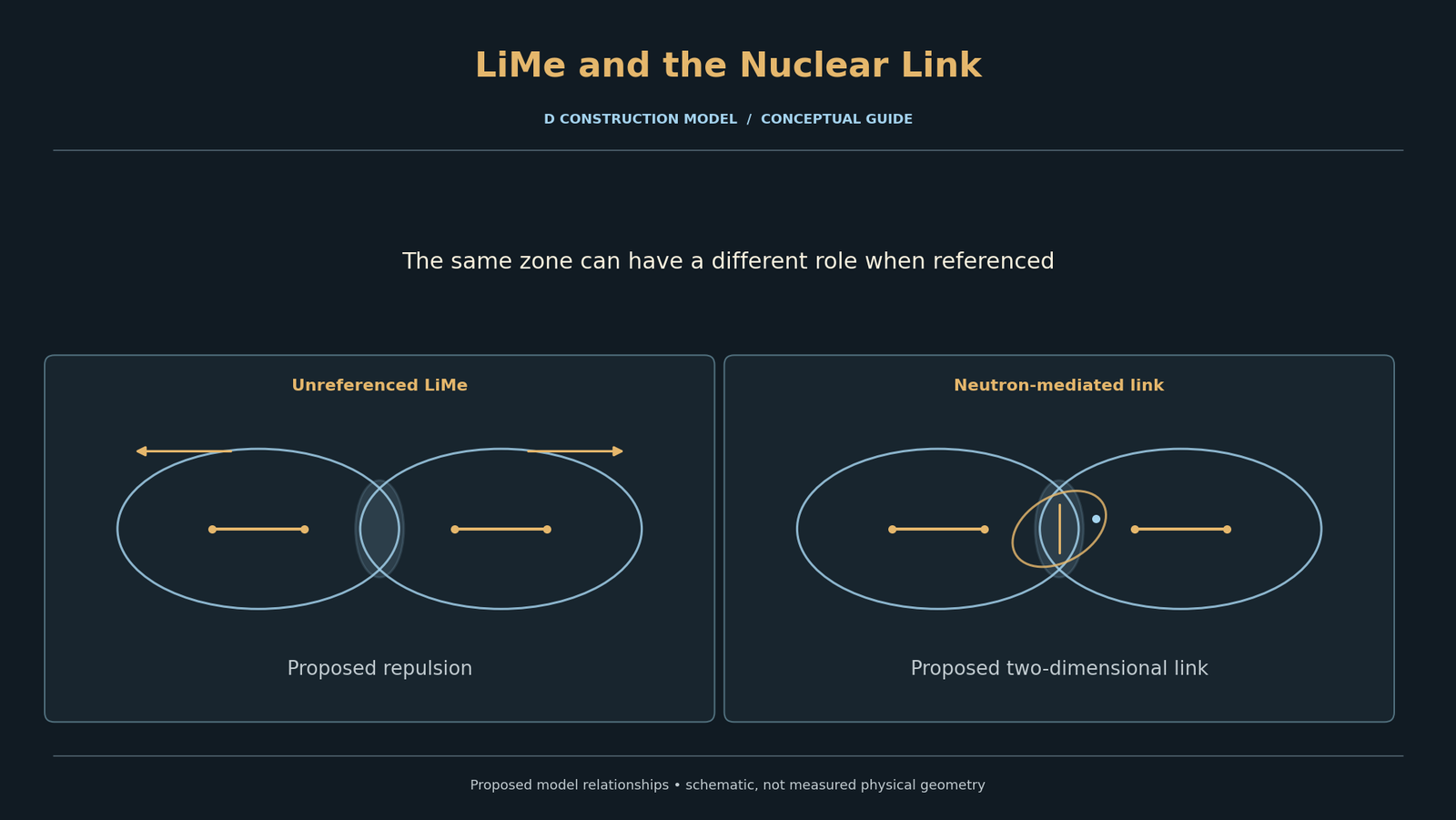
The construction of a nucleus introduces a different relationship from the attraction within a single proton string. When the causal regions of two one-dimensional proton objects overlap, the author identifies an intra-dimensional causal zone, named LiMe.
An unreferenced LiMe zone is proposed to have a repulsive effect. The author therefore asks what happens if another dimensional object can participate within that zone. The neutron is proposed to be a two-dimensional object structurally related to the hydrogen-like arrangement, but situated in the LiMe zone rather than participating as an ordinary atom.
By referencing the dimensional relationship between neighbouring protons, the neutron is proposed to provide a binding link. The proton objects, the neutron and the zone have different roles. LiMe is not a separate material particle. Nor is the neutron simply a point or an additional proton string.
This distinction allows the model to discuss changes in nuclear stability when neutrons are added or removed. Proton number determines the element; the neutron number distinguishes its isotopes. The model seeks to explain their different stability through changes in the available nuclear links and arrangements.
Foundation to retain: LiMe: the proposed causal zone between one-dimensional proton objects; a two-dimensional neutron provides the linking reference.
Audio · Studio recording
Recording slot — add the MP3 or preview a local file.
Recording filename
audio/companion/ii-05.mp3Reading the diagram: Left: two proton strings with a shared unreferenced zone and outward arrows indicating proposed repulsion. Right: a symbolically planar neutron structure in the zone represents the proposed binding reference. The neutron drawing does not assert an exact shape or size.
Optional audio caption 05: Two proton structures introduce a new kind of causal overlap. The model calls it the LiMe zone and proposes that the unreferenced zone gives rise to repulsion. A neutron is described as a two-dimensional object which can reference this zone. In that context it acts as a link between the protons. This is different from the attraction that originally forms a proton string. The proposed distinction connects nuclear stability to the availability of dimensional links.
What this does not establish: Binding energies, nuclear radii, scattering results and isotope stability must be reproduced before the LiMe mechanism can be established.
Source: Narration 10; original Chapter 10 (PDF pp. 68–82).