From a compact nuclear unit to proposed lattices
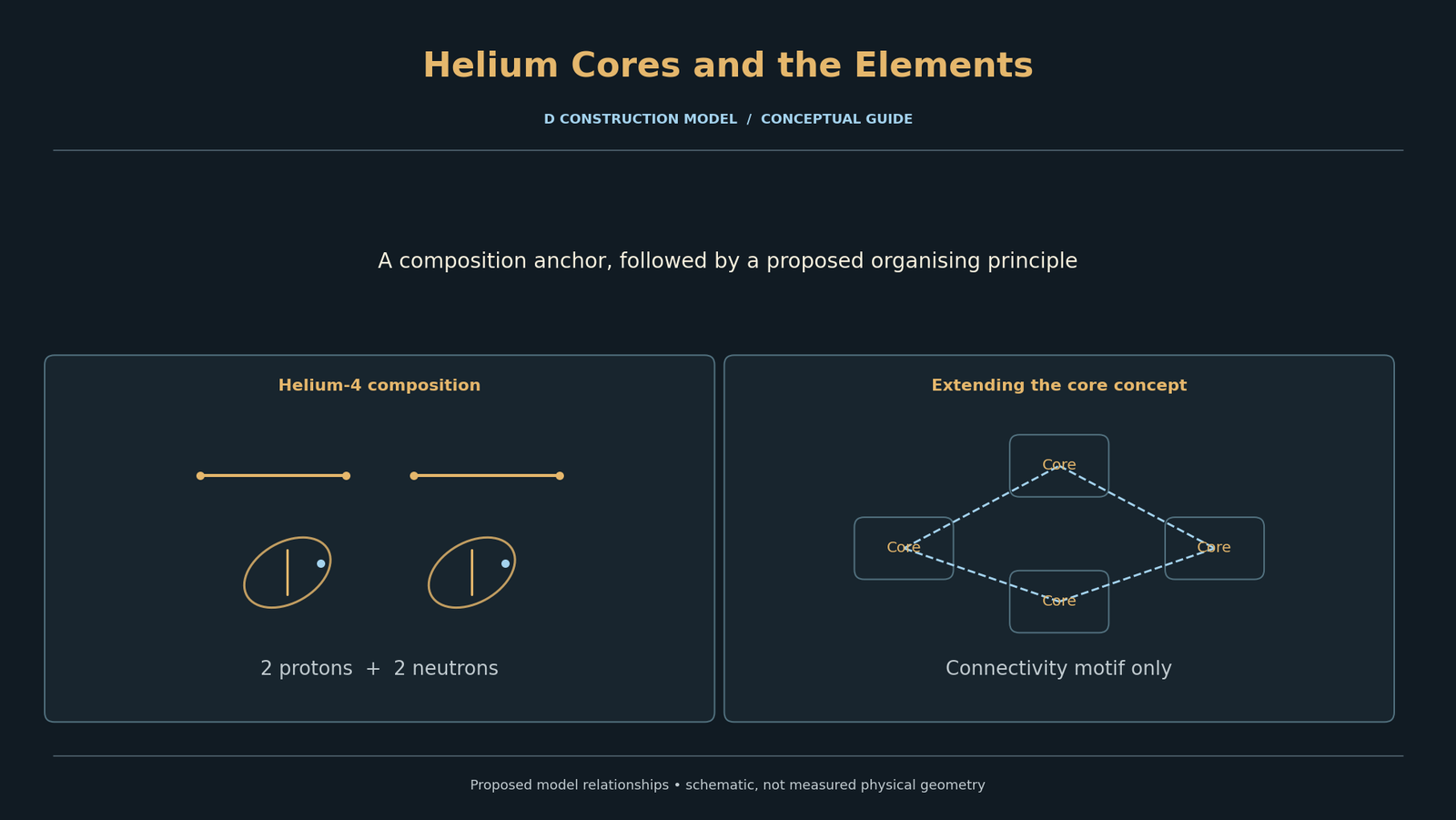
The manuscript uses the helium-4 nucleus, containing two protons and two neutrons, as a particularly important organising structure. Its two proton objects and their neutron-mediated links provide a starting point for constructing more complex nuclei.
The author explores how helium-like units could form latticed arrangements with additional nucleons and available LiMe connections. The intention is to relate the geometry and stability of nuclear cores to the organisation of the periodic table, with particular attention to the noble gases and relative elemental abundances.
This should not be interpreted as a claim that every nucleus consists solely of separate, intact helium nuclei. The manuscript proposes additional links and arrangements. The important question is whether a single underlying construction rule can account for the variety of observed nuclei without adjusting its mechanism separately for each case.
The detailed elemental diagrams are essential for evaluating the proposal. This overview uses a bookkeeping schematic rather than inventing exact lattice coordinates. A later technical annex should reproduce the author-approved layouts for individual elements and isotopes, then compare their proton and neutron counts, stability, nuclear sizes and measured properties.
Foundation to retain: Helium-like cores serve as an organising geometry, with additional nucleons and links proposed to construct larger nuclear arrangements.
Audio · Studio recording
Recording slot — add the MP3 or preview a local file.
Recording filename
audio/companion/ii-06.mp3Reading the diagram: The left panel labels helium-4’s known composition: two protons and two neutrons. The right panel is a connectivity motif illustrating the idea of extending a core. It is not a proposed exact nucleus for any particular element.
Optional audio caption 06: Helium-4 contains two protons and two neutrons. The author uses this compact nucleus as an organising unit for the model’s larger nuclear constructions. By extending the available LiMe links, the model explores lattice-like arrangements and possible patterns of stability. The diagrams must eventually account for each nucleus separately. The schematic here shows the organising idea rather than assigning a specific geometry to an element.
What this does not establish: Nuclear composition alone does not validate a lattice. Noble-gas chemistry must also be distinguished from nuclear stability; the proposed link requires evidence.
Source: Narration 10; original Chapter 10 (PDF pp. 68–82).