Narration chapter 13 — Relativity and the Orientation of Time
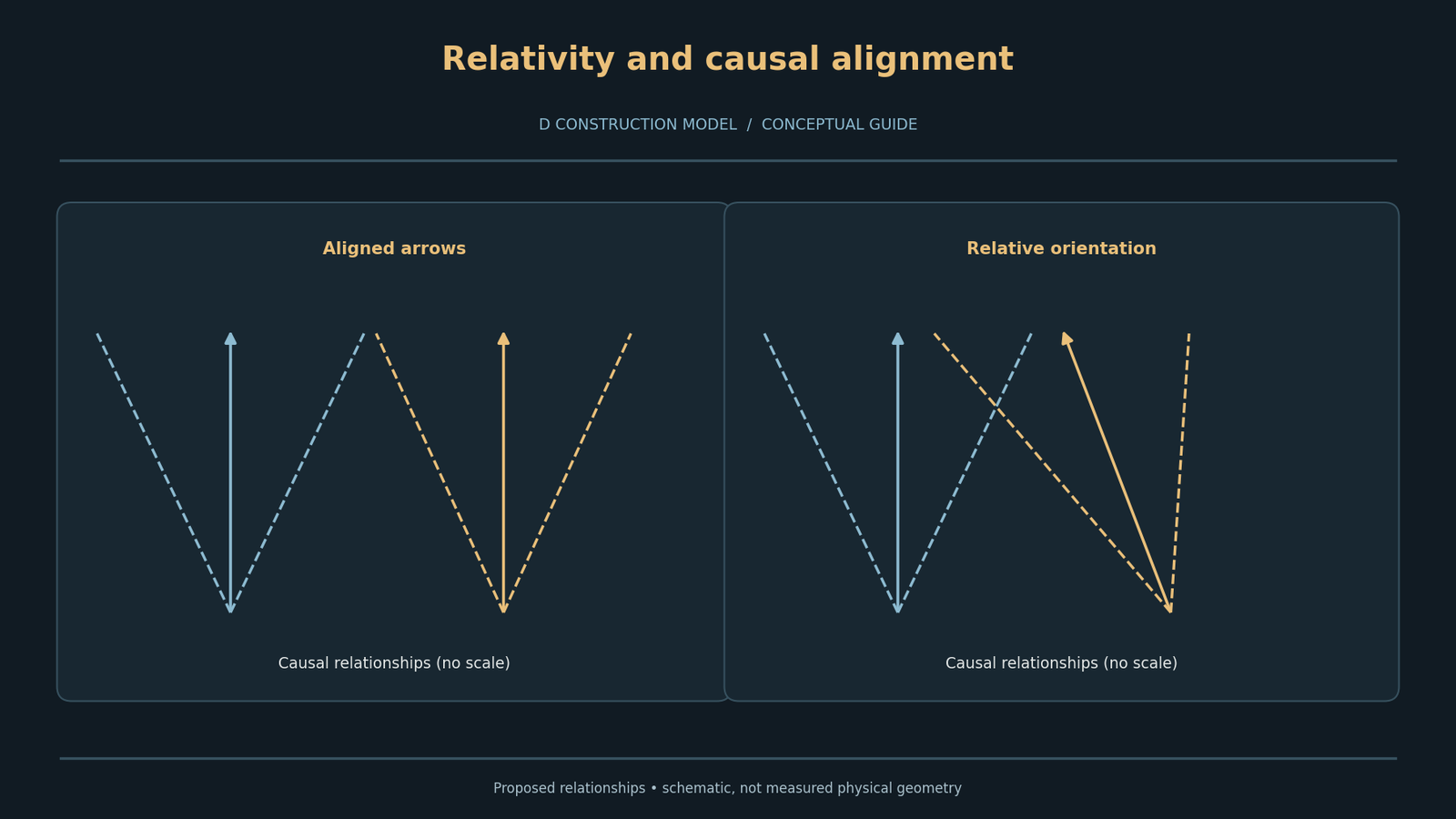
The model associates a time arrow with the direction of dimensional movement. Relative movement changes the orientations and causal access of two systems. The author illustrates this with spacecraft and their differently aligned time arrows, linking the observed differences in time to changes in dimensional referencing.
The original manuscript describes time dilation as a causal illusion and expects differences in received signals. For a rigorous account we need to distinguish signal travel delay, Doppler frequency shift and elapsed proper time measured by clocks. The proposed relation must explain clock comparisons after reunion, not just the appearance of a distant clock.
The author also proposes that movement outside our causal frame may have a different relation to the limiting speed, described using Exo Tempus. This is not automatically a measurable faster-than-light signal. The effect of gravitational acceleration on alignment is intended to link gravitational and motion-dependent time differences.
Principle to retain: Time-arrow orientation describes the proposed relationship between causal histories; it is not yet a numerical transformation law.
Audio · Studio recording
Recording slot — add the MP3 or preview a local file.
Recording filename
audio/companion/iii-03.mp3Figure 03: Two stylised time arrows and causal cones illustrate changes in relative alignment. Their angles are arbitrary schematic choices and have no assigned velocity.
Audio 03: Each system experiences its own orderly sequence. In the model, changing relative movement changes the alignment of time arrows and their causal references. The proposed mechanism must account not only for the signals a distant observer receives but also for the actual elapsed time recorded by clocks.
Research question: Provide a coordinate and metric prescription; derive clock and signal predictions; compare with special and general relativistic tests and prohibit causal contradictions.
Source: Original Ch. 17, PDF pp. 165–176.