Narration chapter 13 — Relativity and the Orientation of Time
Act II described energy as transferable dimensional referencing. In the relativity chapter, the author links conservation to the fact that an interaction can be referenced by several time arrows. A change in one relationship need not erase the reference in another.
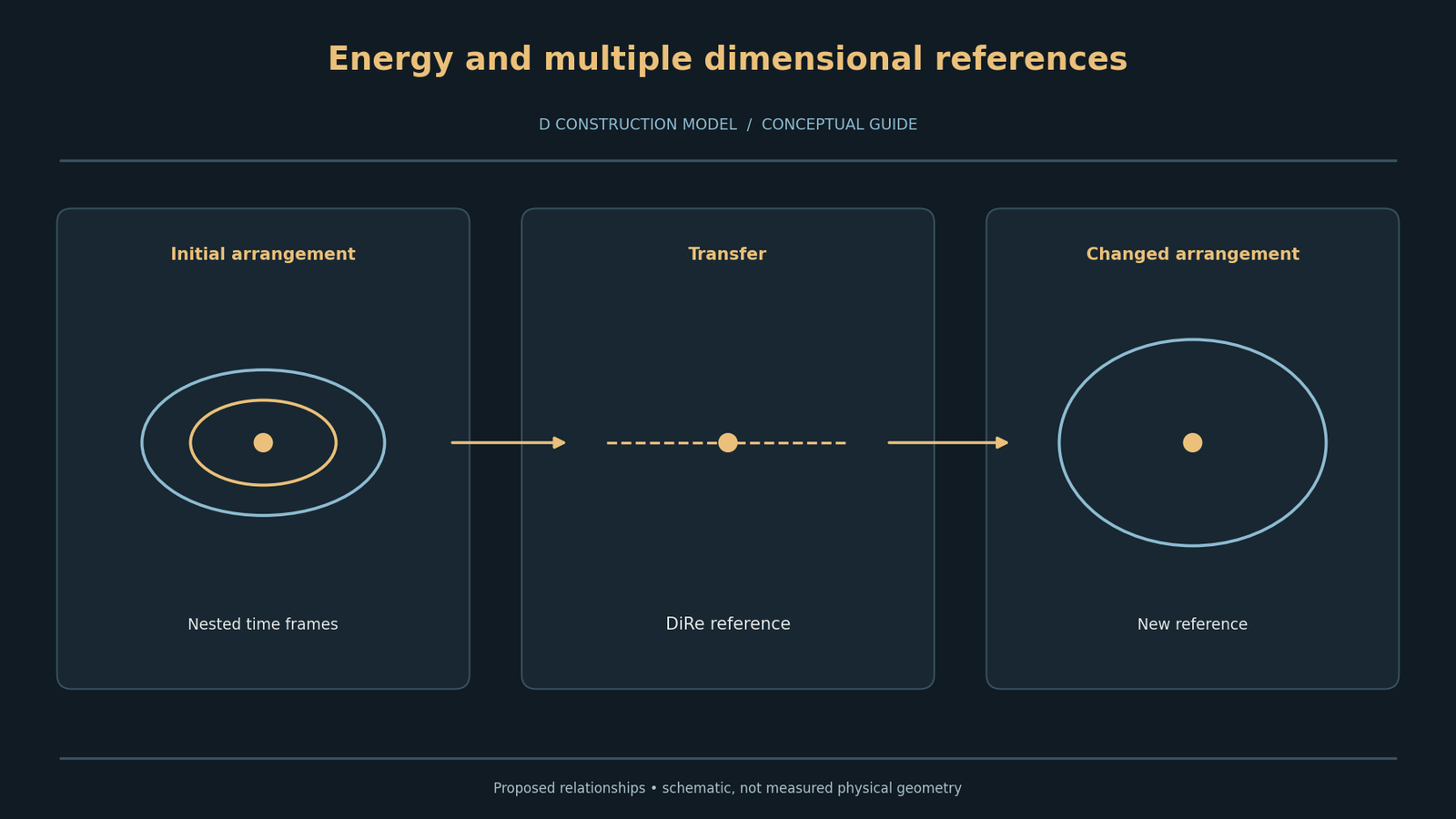
The model therefore proposes that a released reference survives as DiRe radiation and may subsequently enter a different dimensional arrangement. It interprets the persistence of the reference through overlapping causal cones as the basis for energy conservation and the speed of its transfer.
This gives the model an intended physical explanation for continuity. Yet a conservation rule must specify a quantity, and a way of adding and transferring it. A change in the geometry of a drawing cannot by itself prove that a numerical value remains constant. The original model’s possible creation of new GeNions also makes global accounting an important question.
Principle to retain: Reference continuity is a proposed mechanism; quantitative conservation is a result still to be demonstrated.
Audio · Studio recording
Recording slot — add the MP3 or preview a local file.
Recording filename
audio/companion/iii-04.mp3Figure 04: Read the schematic from left to right: an arrangement changes, a reference is transferred, and a receiving arrangement changes. The arrows depict bookkeeping, not a material photon.
Audio 04: The model proposes that a reference does not disappear simply because an interaction changes in one time arrow. It remains part of other dimensional relationships and can be transferred as radiation. To show that this is conservation of energy, we must define a measurable quantity and demonstrate that it is preserved.
Research question: Define the energy functional, transfer rules and conservation domain. Test against measured transitions and matter–radiation interactions, including the proposed origins mechanism.
Source: Original Ch. 17, PDF pp. 173–176; Ch. 9.