Narration chapter 14 — Determinism and the Quantum Perspective
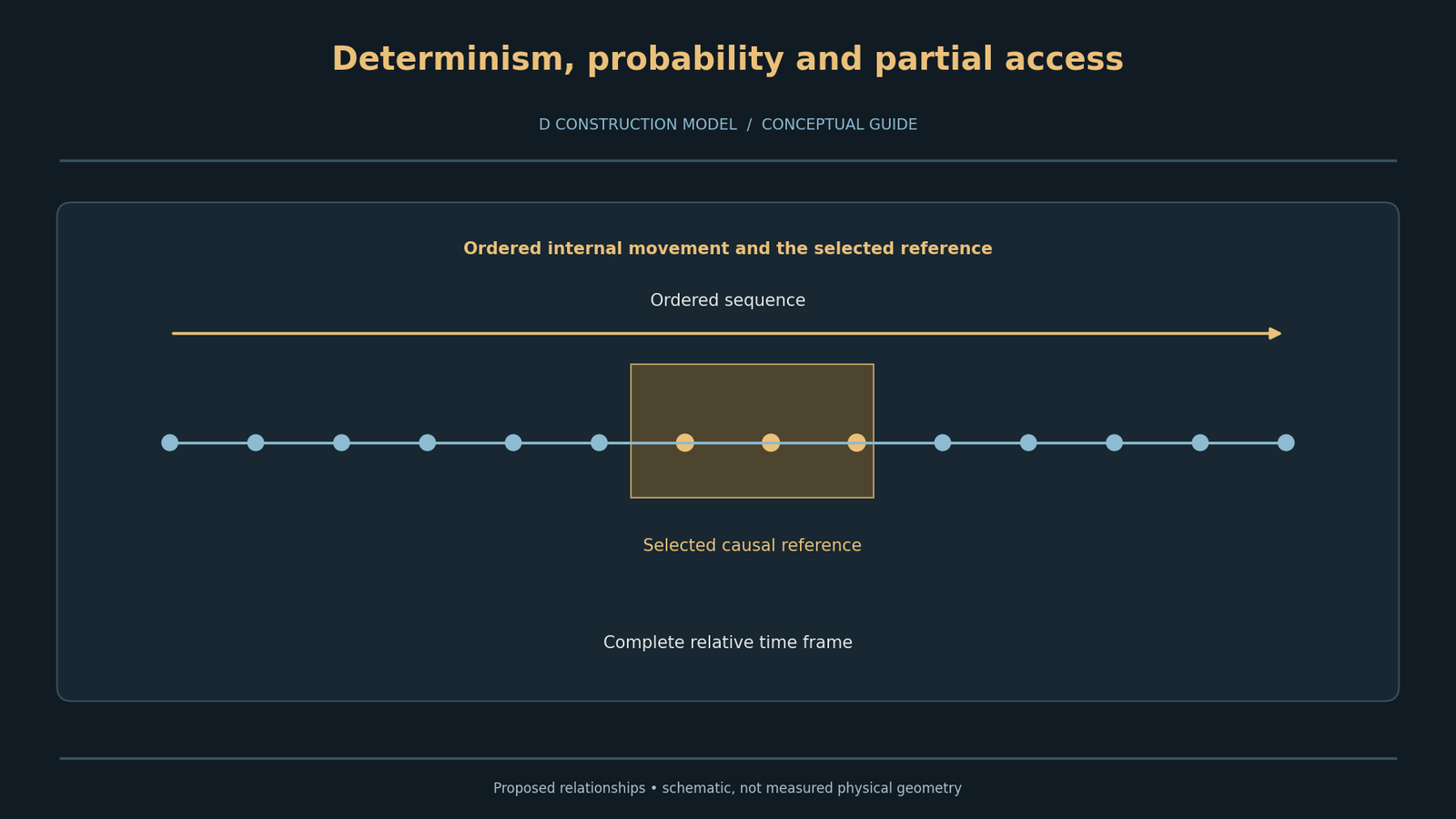
Within any given time arrow the model assumes that interactions follow deterministic rules. This does not guarantee that another time arrow can access that sequence. It may encounter the complete relative time frame as an object or only the portion made available by its causal interaction.
The author returns to Schrödinger’s cat to distinguish stages of a definite movement from alternative outcomes. A time frame of an electron’s orbital movement does not, in this interpretation, represent multiple mutually exclusive histories. The measurement selects a dimensional reference within a continuing interaction.
The model interprets probability as a consequence of which reference is available. A distribution of possible observed positions is not yet a derived probability law: the rule governing which portions are selected, and their relative statistical weights, must be specified. This distinction also prevents determinism being confused with practical predictability.
Principle to retain: The proposed internal history is ordered; access to that history is reference-dependent.
Audio · Studio recording
Recording slot — add the MP3 or preview a local file.
Recording filename
audio/companion/iii-05.mp3Figure 05: A sequence of points represents an ordered movement. A larger bracket denotes the complete time frame, while a gold window denotes a selected reference. No probabilities are inferred from the drawing.
Audio 05: Within its own time arrow, the model says that an interaction follows a definite sequence. A further dimensional interaction may encounter the whole time frame or only one part of it. Probability is proposed to arise from that restricted access, not from an absence of internal causality.
Research question: Derive a mathematically normalised distribution and measurement-selection rule. Show whether the model reproduces observed quantum statistics rather than assuming a correspondence.
Source: Original Ch. 18, PDF pp. 176–189; Ch. 7.