Narration chapter 14 — Determinism and the Quantum Perspective
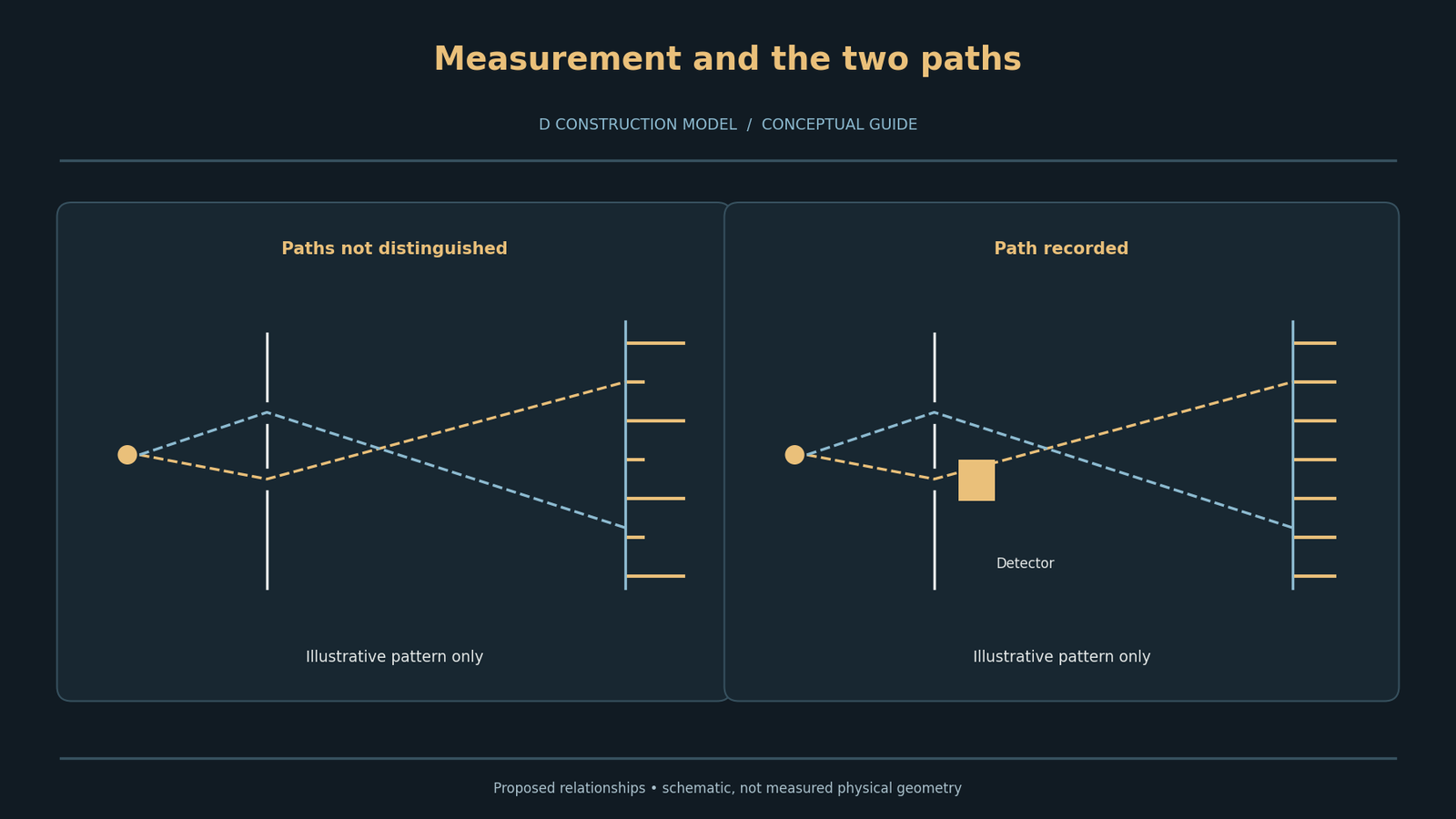
The double-slit experiment is a test of how a physical measurement arrangement affects the accumulation of detections. With suitable coherence and indistinguishable paths, an interference pattern can form. Path-distinguishing interactions can reduce or remove it.
The D Construction Model attributes the difference to the dimensional time frame available for interaction. Recording a path establishes a reference which changes the set of relationships that remain accessible. In the author’s account, a measurement is a new physical interaction rather than a passive act of looking.
The same underlying idea is used to reconsider entanglement, in which two objects retain a correlated dimensional relationship. However, fixed opposing values alone cannot reproduce the full correlations for different measurement settings in Bell experiments. A developed model must address the relevant assumptions and derive joint statistics.
Principle to retain: The record-producing interaction matters; no special role for human awareness is established.
Audio · Studio recording
Recording slot — add the MP3 or preview a local file.
Recording filename
audio/companion/iii-06.mp3Figure 06: Two minimal slit layouts compare unrecorded and path-recorded cases. The right-hand marks indicate a different pattern qualitatively; they are not calculated intensity curves.
Audio 06: The model interprets the two-slit pattern as an interaction with a wider dimensional time frame. A physical path record changes the reference available to the system. It is this interaction, rather than someone consciously looking, that is proposed to change the outcome. Quantitative interference and entanglement predictions are still required.
Research question: Calculate interference visibility for different path information and derive Bell-test correlations with explicit measurement settings and no-signalling constraints.
Source: Original Ch. 18, PDF pp. 178–188; Ch. 7.