Narration chapter 15 — The Universe
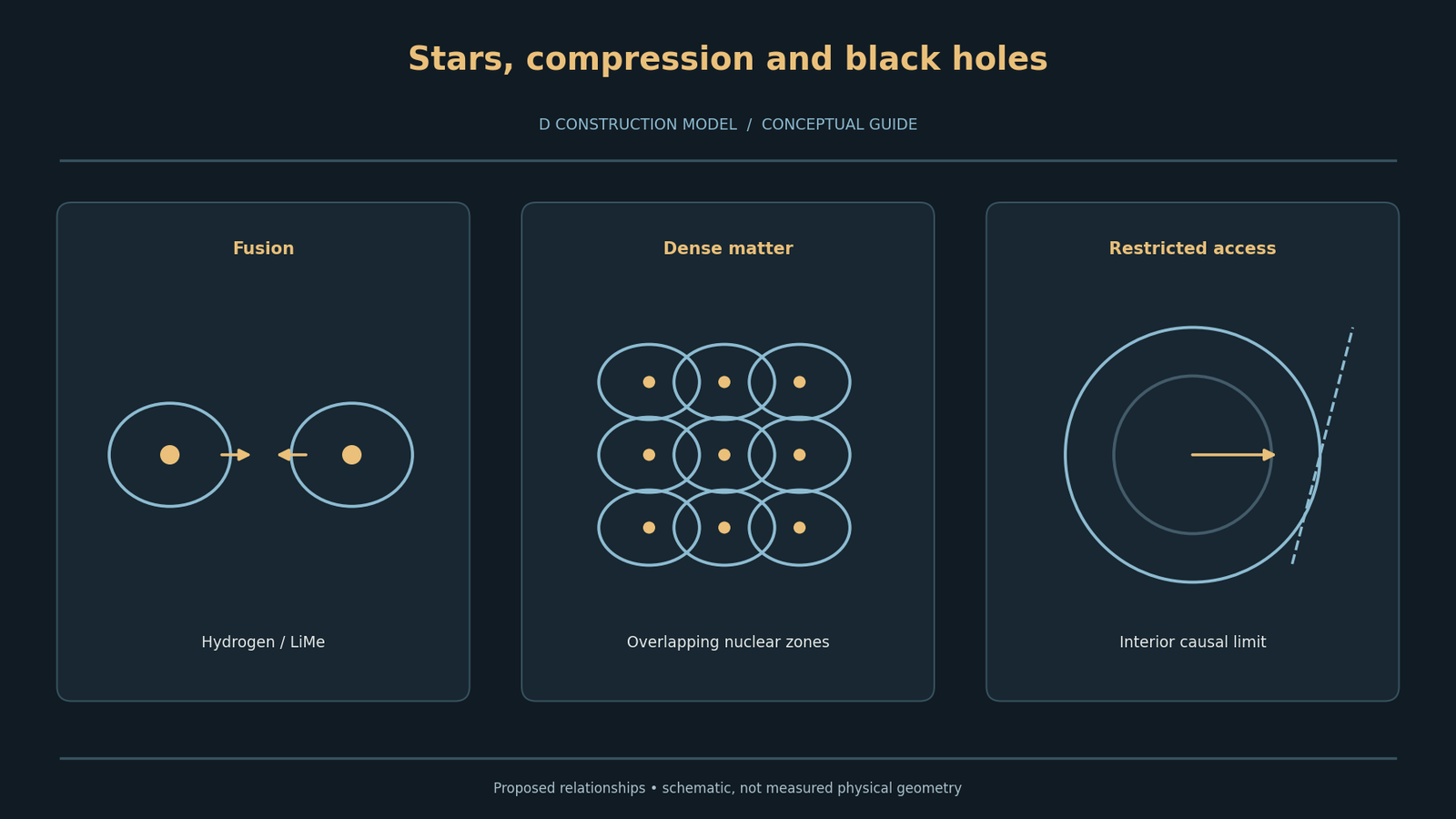
In the author’s fusion proposal, gravitational compression allows hydrogen structures to enter LiMe zones, producing neutron references required for helium nuclei. Released references are transferred as radiation and heat. This extends the proposed nuclear mechanism of Act II to stellar conditions.
Under extreme compression the manuscript proposes that overlapping LiMe zones dominate, restricting ordinary proton references and leaving neutron-like nuclear matter. Actual neutron stars may contain several constituents; the schematic does not establish their composition or equation of state.
For black holes, the author proposes that higher-dimensional movement changes causal orientation until the interior ceases to interact directly with our time arrow. Exo Tempus describes the inaccessible relationship. The manuscript uses indirect causal links to discuss continuing gravitational effects. The analogy must be distinguished from an established event-horizon geometry.
Principle to retain: The model extends nuclear referencing under compression and introduces a proposed limit of causal access.
Audio · Studio recording
Recording slot — add the MP3 or preview a local file.
Recording filename
audio/companion/iii-07.mp3Figure 07: Three conceptual panels represent increasing compression, LiMe-dominated matter and restricted direct access from an interior. They are not an evolutionary sequence applying to every star.
Audio 07: The stellar applications extend the model’s nuclear and gravitational principles. Compression is proposed to alter the available nuclear references. At the extreme, the author interprets black-hole interiors through limited causal access. These proposals need to account for the observed properties of both neutron stars and black holes.
Research question: Derive fusion reaction rates, the dense-matter equation of state, mass–radius relations and horizon behaviour; compare with stellar evolution, compact-object observations and gravitational waves.
Source: Original Ch. 19, PDF pp. 189–194.