Narration chapter 15 — The Universe
LiMe, MiFa and SaCa are the lower-dimensional causal zones introduced in Act II. The manuscript extends this idea to overlapping fourth-dimensional causal regions, called VeRu in honour of Vera Rubin. Its required referencing object is explicitly unresolved.
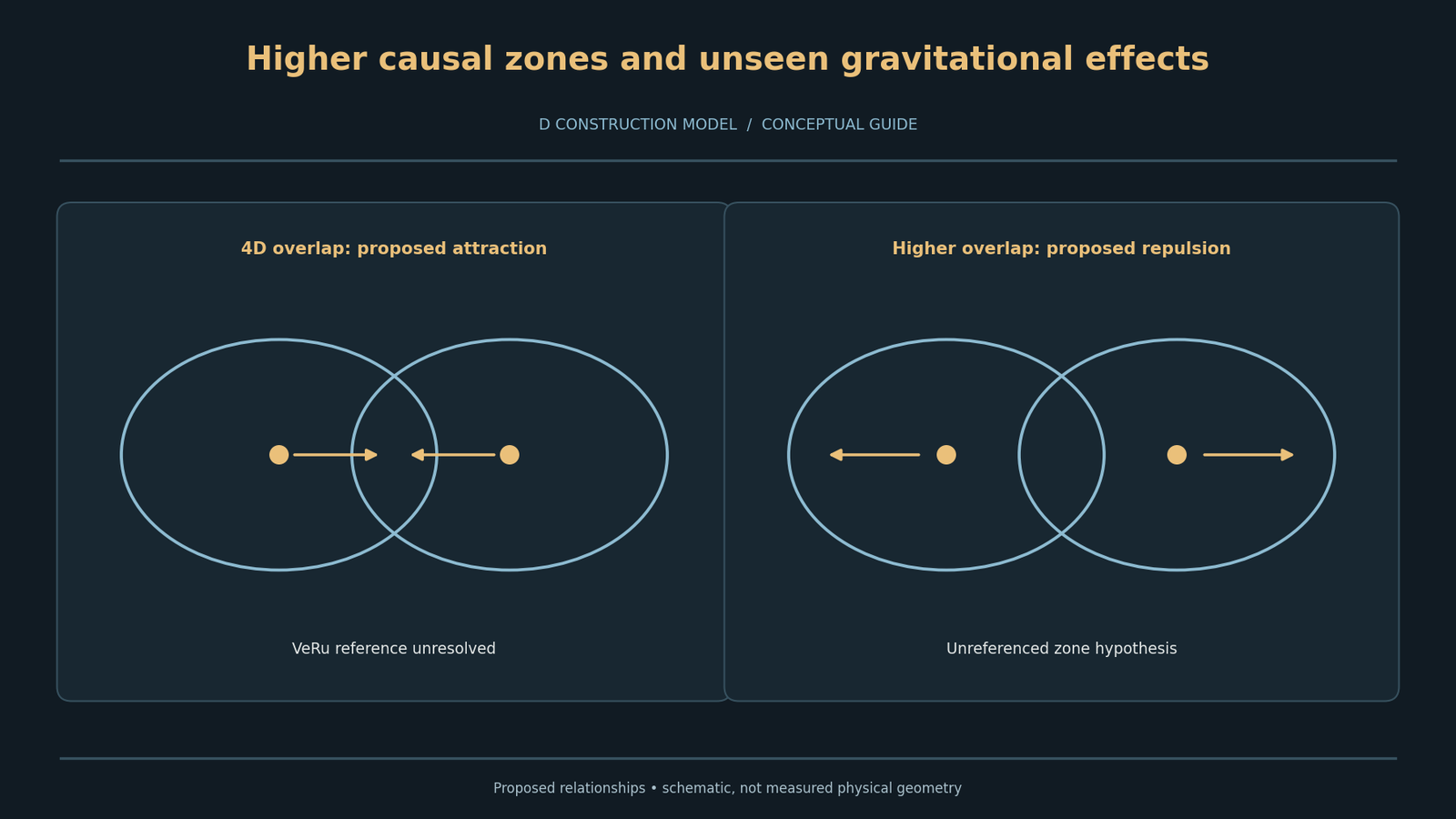
The author suggests a fourth-dimensional overlap might provide additional attraction within galaxies. A fifth-dimensional overlap that cannot be referenced might yield repulsion between galaxies. These follow the model’s general distinction between referenced binding zones and unreferenced repelling zones, although the extension is not worked out.
The intent is to investigate other possible explanations for phenomena attributed to dark matter and dark energy. Galaxy rotation alone is insufficient to establish such an alternative. The mechanism must also account for lensing, cluster observations, large-scale structure and the history of cosmic expansion.
Principle to retain: VeRu extends the InDiCa framework as a hypothesis; its contents and governing law remain open.
Audio · Studio recording
Recording slot — add the MP3 or preview a local file.
Recording filename
audio/companion/iii-10.mp3Figure 10: The left panel denotes a possible extra attraction associated with galactic-scale overlap; the right denotes a proposed repulsive higher overlap. No strength, geometry or range is assigned.
Audio 10: If the causal-zone construction continues at higher dimensions, the author proposes that overlapping regions might influence the motion of galaxies. A referenced overlap might reinforce attraction, while an unreferenced overlap might produce repulsion. The precise nature of the higher zones, including VeRu, remains to be defined.
Research question: Determine the existence, referencing rule, range and force strength of VeRu and higher zones; calculate predictions for multiple independent cosmological observables.
Source: Original Ch. 19, PDF pp. 200–203; glossary p. 222.