Narration chapter 16 — Life and Consciousness
The model proposes that the sustained activity of living organisms gives their complete time frames a different fourth-dimensional structure from those of non-living systems. This focuses on the organisation and continuity of interactions rather than a single physical snapshot.
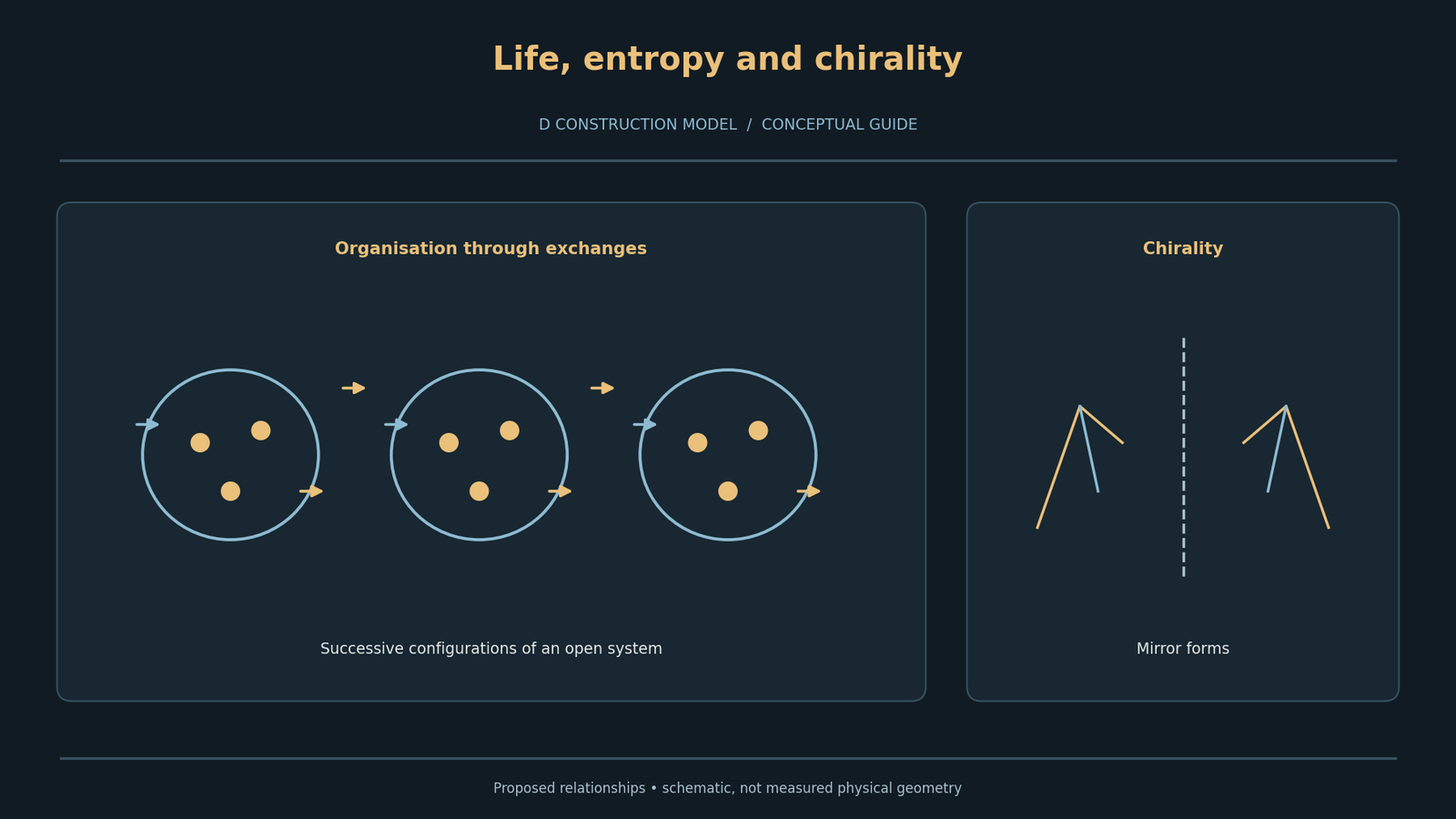
A living system maintains local organisation by interacting with its surroundings. The manuscript interprets this in terms of wider dimensional energy flow. The proposed higher-dimensional account must not be confused with a violation of the second law: local order can increase in an open system while total entropy production is non-negative.
The author also explores whether time-arrow orientation could contribute to the handedness of biological molecules and the organisation of genetic information. He speculates that changing dimensional relationships might limit the conditions under which life can exist. These possibilities require a mechanism beyond the qualitative resemblance to geometry.
Principle to retain: Life is proposed to have an organised time-frame structure, not a new fundamental substance.
Audio · Studio recording
Recording slot — add the MP3 or preview a local file.
Recording filename
audio/companion/iii-11.mp3Figure 11: Follow successive configurations of an organised system exchanging resources. The mirror forms symbolise chirality; they are not proposed molecular structures.
Audio 11: A living organism maintains its organisation through continuing exchanges of matter and energy. The model proposes that this sustained pattern gives life a distinctive higher-dimensional structure. It also asks whether the orientation of time arrows might influence molecular handedness. Neither proposal is yet a biological mechanism.
Research question: Specify a measurable distinction between living and non-living time frames; model entropy in an open system and derive testable molecular chirality predictions.
Source: Original Ch. 20, PDF pp. 203–211.