Narration chapter 16 — Life and Consciousness
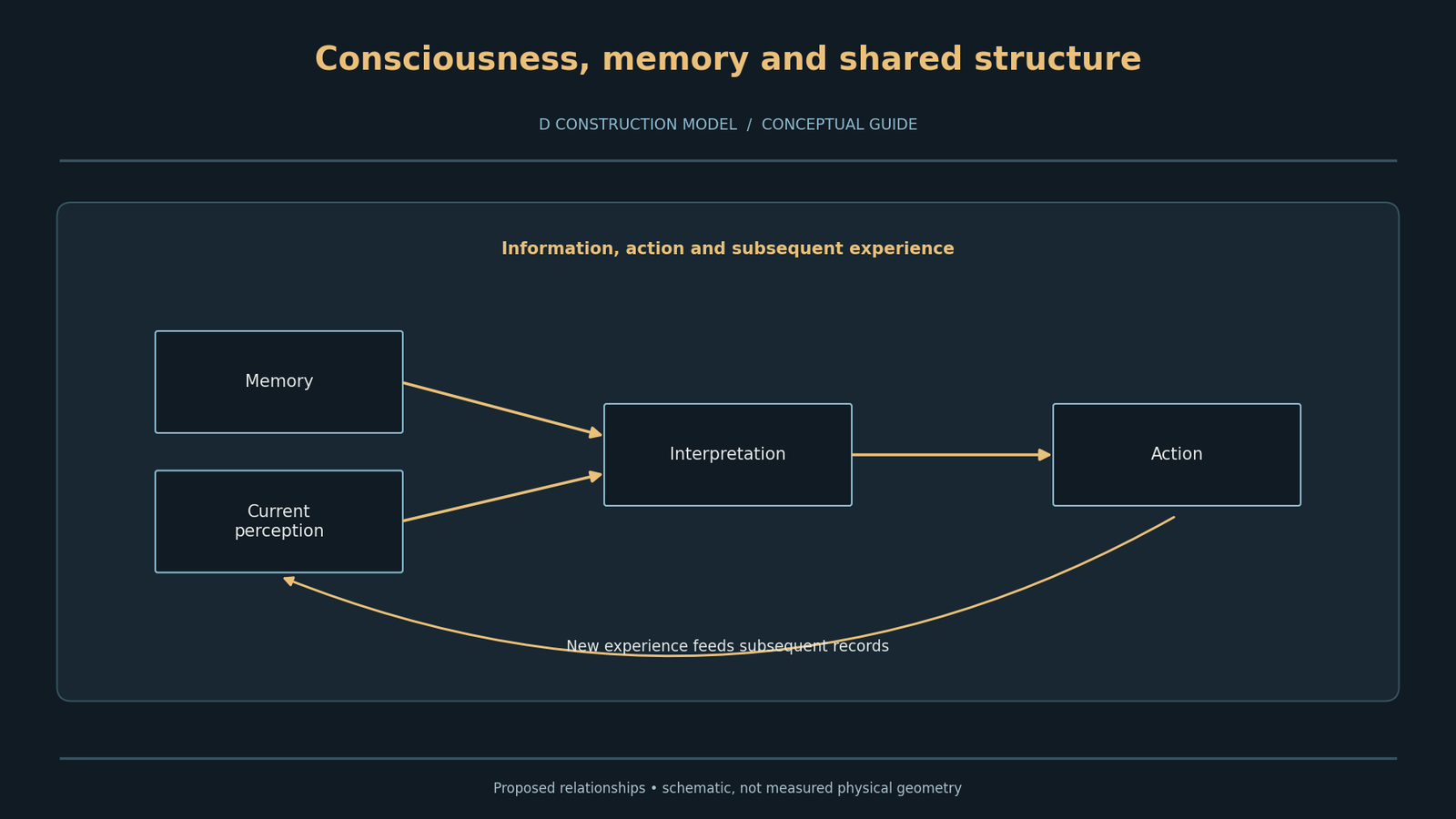
The author describes consciousness as using information from previous time frames to guide action in fourth-dimensional time. Memories enable interpretation of current events and the anticipation of possible outcomes. The model treats this ongoing organisation as a possible fourth-dimensional structure.
The manuscript explores whether recording information changes dimensional references, drawing an analogy with the measurement discussion in Chapter 18. It then proposes that sleep may reframe recorded dimensional information. Neither analogy provides an established neurological mechanism.
Finally, the author suggests that interactions between individuals contribute to a larger higher-dimensional object. This philosophical conclusion follows from applying the construction principle to human relationships. It does not imply demonstrated shared consciousness, survival after death or an independently verified mental field.
Principle to retain: The model’s interpretation of consciousness concerns the temporal organisation of information; it is not a demonstrated explanation of subjective experience.
Audio · Studio recording
Recording slot — add the MP3 or preview a local file.
Recording filename
audio/companion/iii-12.mp3Figure 12: Read the information-flow sketch as memory and current perception contributing to interpretation and action. The feedback arrow represents subsequent experience feeding new records; it is not a neural circuit.
Audio 12: We use records of previous experiences and current information to anticipate the consequences of action. The author describes this as navigating fourth-dimensional time through earlier time frames. The proposed structure may be a way to consider consciousness, but its biological mechanisms and empirical implications remain open.
Research question: Identify a neural or behavioural observable that distinguishes the proposed memory and sleep mechanism from established descriptions. Avoid inferring metaphysical claims without evidence.
Source: Original Ch. 20, PDF pp. 211–215.